Building Our First ML Model — The Final Term Project and Exhibition
For our final term in first semester, we built a Machine Learning model on an online marketing dataset and presented it at a university exhibition.
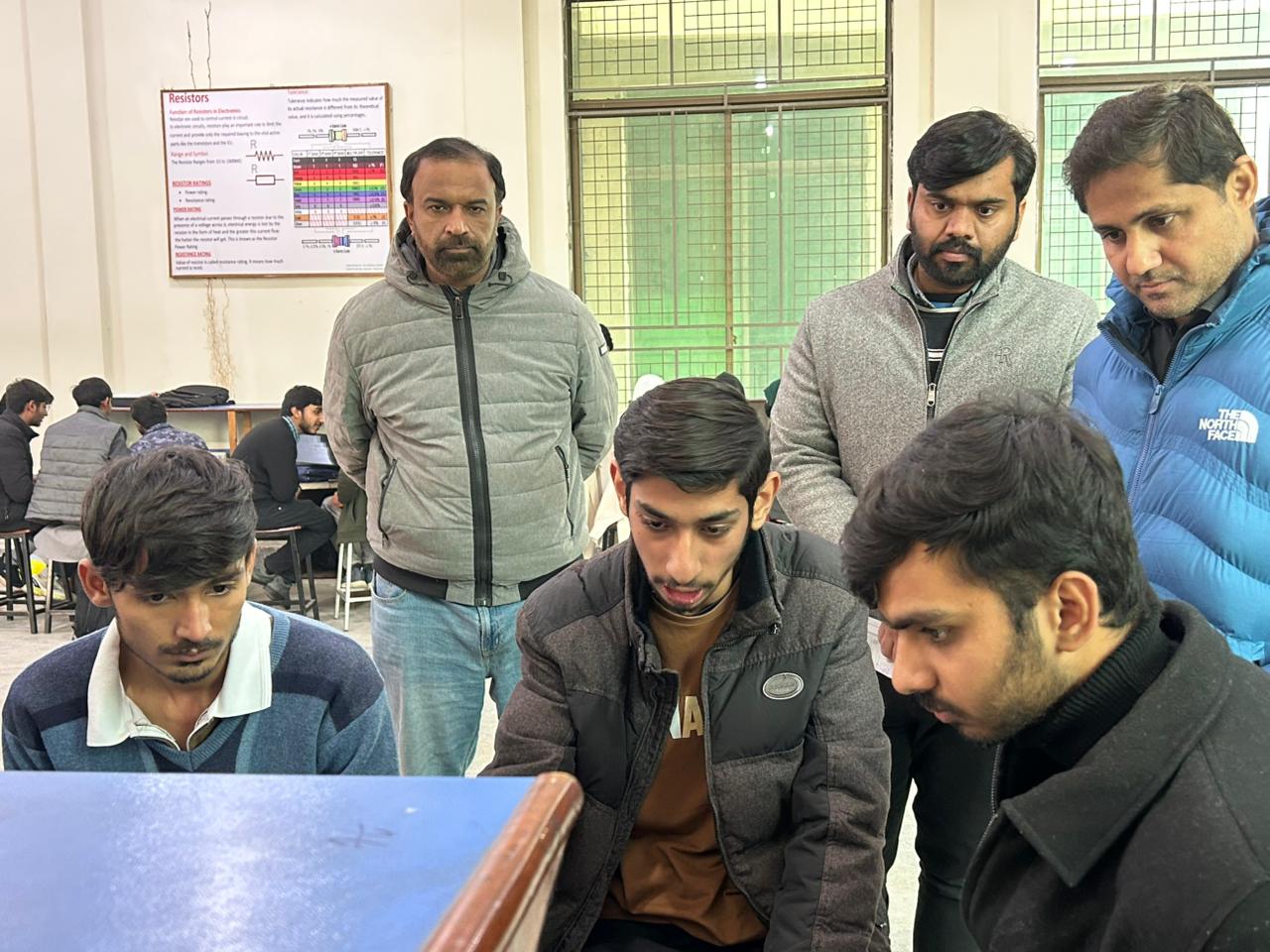
The final term project of first semester was the moment when everything we had learned stopped being theoretical and became something we had to actually use. Not in a lab exercise with clear instructions and a known answer waiting at the end, but in a real project with a real problem, real data, and a real audience who would evaluate what we built and ask us questions about the choices we made. That shift — from following instructions to making decisions — was the most significant intellectual transition of my first year at UET Faisalabad, and the project that produced it was a Machine Learning model built on an online marketing store dataset.
The starting point was the data itself. An online marketing dataset contains records of customer behavior — pages visited, time spent browsing, products viewed, items added to cart, whether a session ended in a purchase or not. The volume of information in such a dataset is large, and the first challenge was not building a model but understanding what question we actually wanted the model to answer. After working through the possibilities, we settled on a binary classification problem: given the features of a user’s browsing session, could we predict whether that session would result in a purchase? It was a well-defined problem with clear business value, and it gave us a concrete target to work toward rather than a vague directive to do something interesting with the data.
Data cleaning was the first major task, and it was more demanding than I had anticipated going in. Real data is not clean. It contains missing values that need to be handled — either filled with reasonable estimates or removed if they affect too many records. It contains categorical variables that need to be converted into numerical form before any algorithm can process them. It contains outliers that can mislead a model if left unaddressed, and features that are so strongly correlated with each other that including both adds noise rather than information. Working through these issues one by one, making decisions about each one and understanding the reasoning behind those decisions, taught me more about data and its relationship to modeling than any lecture on the subject could have conveyed. Preparation, I learned, is where the actual work of machine learning happens. The model itself is almost the easy part.
With clean data prepared, we moved into feature selection and model building. We explored decision tree classifiers, which build a series of if-then rules based on the features in the data, and random forests, which build many decision trees on different subsets of the data and combine their predictions for more robust results. Training a random forest in Scikit-learn required very few lines of code — the library handles the mathematical complexity entirely — but understanding why it worked, what it was doing internally, and how to interpret its outputs required engagement with the underlying concepts that the code alone did not provide. I spent time reading about ensemble methods, about how bootstrap sampling and feature randomization reduce overfitting, about what the feature importance scores produced by random forests actually measure. That reading, done outside of class and outside of assignment requirements, was some of the most valuable learning I did that semester.
Evaluating the model produced its own set of lessons. Accuracy — the percentage of predictions that were correct — seemed like the obvious metric to optimize for, but our dataset had a class imbalance: more sessions did not result in purchases than did. A model that simply predicted “no purchase” for every session would achieve high accuracy while being completely useless. Learning about precision, recall, and the ROC-AUC score — metrics that give a fuller picture of classifier performance and are specifically designed to handle imbalanced classes — was one of the more practically important technical lessons of the project. It changed how I thought about what it means for a model to be good at its task, and it made me more skeptical of simple metrics in general.
The exhibition was where the project became something more than a technical exercise. We set up our work and presented it to teachers and evaluators who came to assess what different groups had built. Standing in front of what you have made and explaining it to people who understand the field is an experience that no lab assignment can replicate. Every decision you made during the project becomes something you might be asked to justify. Every number in your results needs to be understood well enough to explain what it means and why it matters. Every assumption you made in your preprocessing or your model selection needs to be defensible. I had prepared for the technical questions, but the experience of actually answering them in real time — staying composed, thinking clearly, communicating precisely — was its own kind of education.
The feedback we received was direct and useful. Some of our choices were questioned, some of our results were probed for their limitations, and some aspects of our approach were identified as areas for improvement. Receiving that feedback in a public setting, in front of an audience, was uncomfortable in a way that I think was entirely appropriate. Engineering work is evaluated. It is judged against standards by people who understand those standards. Learning to receive that evaluation without becoming defensive, to engage with criticism as information rather than as an attack, and to leave the conversation with a clearer understanding of what could be better — that is a professional skill that the exhibition gave me my first real practice with.
That first ML project, from the initial data exploration to the final exhibition, was the defining experience of my first semester at UET. It brought together everything the semester had built — Python, data handling, libraries, modeling, evaluation, communication — into a single coherent piece of work. It showed me what engineering actually feels like when the pieces come together, and it set a standard for the kind of work I wanted to do going forward.
Building ML models on real datasets is work that connects directly to serious research. For an example of what that looks like at the professional level, see Dr. Bilal Ahmad’s work on LinkedIn.