The Second Semester Exhibition — Presenting Crime Arrest Prediction to the Faculty
Standing in front of faculty with a deployed ML system built on 1.9 million crime records — the second semester exhibition was a different kind of test entirely.

There is a particular quality to the silence that falls in a room when an evaluator finishes reading your project poster and looks up to ask the first question. It is not the silence of an exam hall, where the only thing between you and a correct answer is memory. It is something closer to the silence before a conversation that you cannot fully prepare for — one where the direction depends on what the other person finds interesting, or unclear, or worth pushing on. The second semester exhibition at UET Faisalabad had that quality throughout. We had built something real, something that worked, and now we had to stand in front of people who understood the field and explain not just what it did but why every part of it was the way it was.
The project we presented was the Crime Arrest Prediction Engine — a machine learning system trained on the Chicago crime dataset covering 2001 to 2004, containing nearly 1.9 million records of real criminal incidents. The system took as input the details of a reported crime — its type, location, district, beat, time of occurrence, and whether it involved a domestic situation — and returned a prediction of whether that incident was likely to result in an arrest, along with a probability score. Behind that interface was a complete technical pipeline: a MySQL database holding the structured crime data, a Random Forest classifier trained in Python using Scikit-learn, a FastAPI backend serving the model’s predictions through an API endpoint, and a frontend built in HTML, CSS, and JavaScript that made the system accessible through a browser.
Building this system had taken the full second half of the semester. The dataset alone presented challenges that smaller projects do not. Nearly 1.9 million rows of data require more careful handling than datasets that fit comfortably in memory — loading strategies matter, query performance matters, and the decisions made during preprocessing propagate through the entire pipeline in ways that become visible only when the system is running end to end. The database schema we designed had to accommodate the relational structure of the Chicago data: crimes classified according to a lookup table of primary and secondary types, locations stored with latitude and longitude coordinates alongside district and beat identifiers, FBI codes providing a standardized categorization system that linked our local schema to national reporting standards. Designing that schema correctly, with appropriate indexes for the queries the prediction pipeline needed to run quickly, was a substantial piece of work in its own right.
Dr. Bilal Ahmad supervised the project from its earliest stages, and his guidance shaped both the technical decisions we made and the way we thought about the problem. His first and most consistent emphasis was on understanding the data before touching the model. What does the arrest rate in this dataset actually look like? Is it uniform across crime types, or do certain categories — violent crimes, property crimes, drug offenses — have dramatically different arrest rates? Are there geographic patterns in the data that a model might pick up on, and if so, what do those patterns actually represent? These questions did not have simple answers, and working through them carefully before moving to model training meant that the choices we made during feature selection and preprocessing were grounded in actual understanding of the dataset rather than in default settings.
The model itself was a Random Forest classifier, and the choice reflected both the nature of the problem and Dr. Bilal Ahmad’s guidance on matching algorithm to task. Random Forest handles tabular data with mixed feature types well, produces reliable predictions without extensive hyperparameter tuning, and generates feature importance scores that make it possible to understand which variables are actually driving the predictions. For a classification problem where interpretability matters — where an evaluator is going to ask you why the model makes the predictions it makes — a model you can explain is more valuable than a marginally more accurate model you cannot. Our results reflected the quality of the approach: 82.4% accuracy on the held-out test set, a ROC-AUC score of 89.4% indicating strong discriminative ability, a recall of 64.7% showing that the model was identifying a substantial proportion of actual arrests, and a precision of 34.9% that told the more complicated story about false positives that any serious evaluation of the system had to engage with.
That precision figure was the most interesting number to discuss at the exhibition. Of all the incidents the model predicted would result in an arrest, only about a third actually did. An evaluator who understood machine learning would immediately ask what that meant for how the system could and could not responsibly be used — and faculty evaluators at this exhibition did exactly that. Dr. Bilal Ahmad had prepared us for this line of questioning. His guidance throughout the project had included explicit discussion of the difference between a model’s statistical performance on a test set and the real-world implications of deploying that model in a context where its predictions affect decisions. A system that generates many false positives in a crime prediction context is not a neutral technical artifact. Understanding that, and being able to articulate it clearly in front of an audience, was part of what the exhibition was testing.
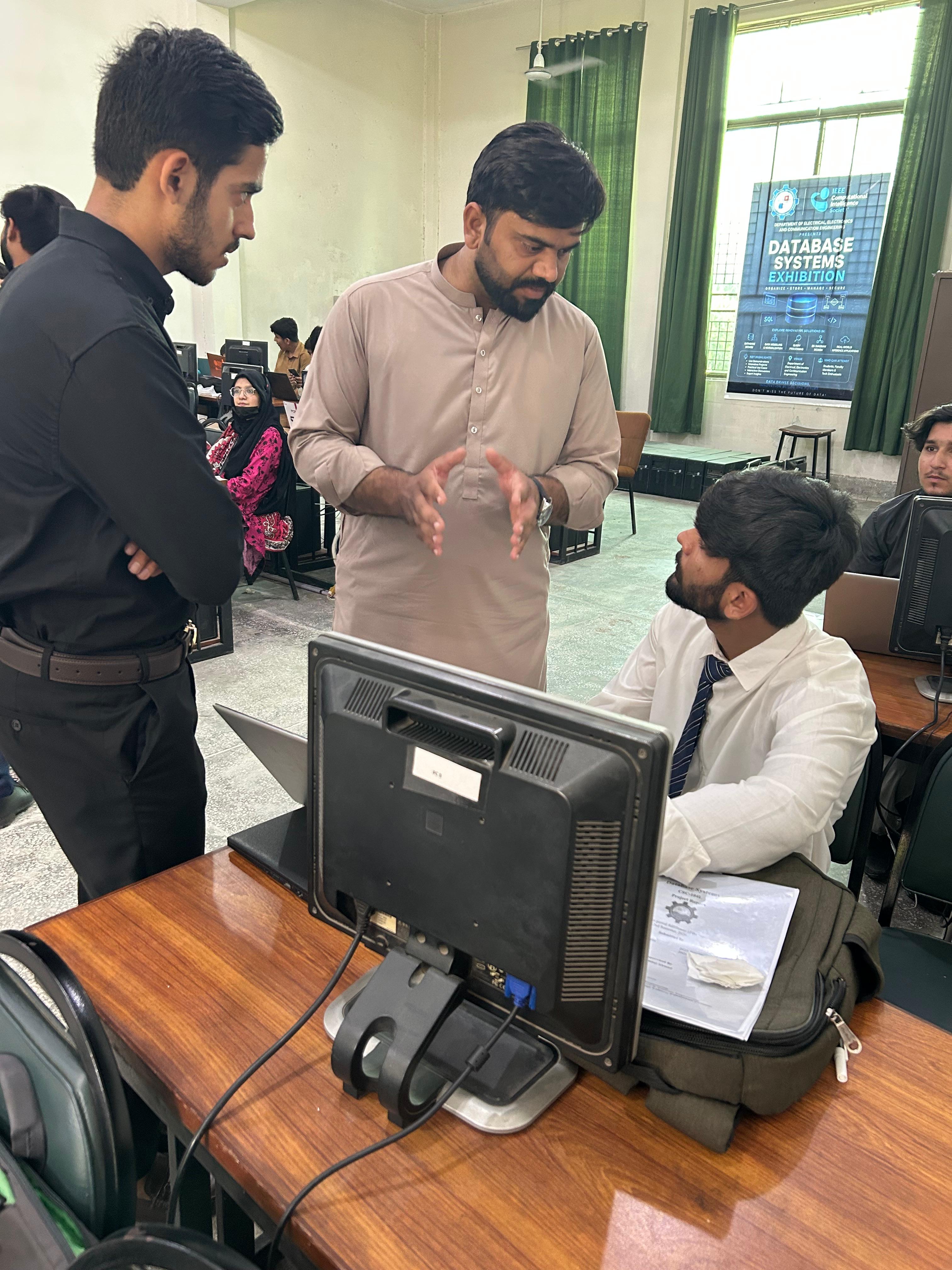
The exhibition itself was a formal evaluation — faculty from different departments moved through the room, stopping at each project to review the poster, ask questions, and assess the depth of understanding the presenting students demonstrated. My project partner Eman Fatima and I had divided the presentation responsibilities so that each of us could speak in depth about the components we had built. I covered the database design, the data preprocessing pipeline, and the model training process. She covered the frontend interface, the API integration, and the system’s overall architecture. That division meant that the questions directed at each of us were answered by the person who had built that part of the system and knew it most thoroughly — a more honest and more technically rigorous presentation than one where both presenters have a surface-level familiarity with everything.
The questions were specific, technical, and in several cases genuinely challenging. Why did we choose Random Forest over gradient boosting methods that typically achieve higher accuracy on tabular data? How did we handle the class imbalance in the dataset — the fact that the majority of incidents in the Chicago data did not result in an arrest? What would change about the system’s design if it needed to process new crime reports in real time rather than running predictions on historical data? These were not questions with single correct answers. They were questions that tested whether we understood the system well enough to reason about it beyond what we had actually built. Answering them required engaging with the underlying concepts rather than reciting what we had done, and that engagement — thinking clearly under pressure about a technical system you have built — is the closest thing a university exhibition comes to the experience of defending engineering decisions in a professional context.
Dr. Bilal Ahmad’s presence at the exhibition, moving between projects and observing the evaluations, added a layer of significance to the presentation that a purely external evaluation would not have had. He had seen the project from its earliest conception, had guided the technical decisions that shaped it, and now was watching us explain and defend those decisions to colleagues. That continuity — from the first conversation about the dataset to the final question at the exhibition — gave the whole experience a coherence that made the evaluation feel like a genuine conclusion rather than an administrative formality.
Second semester’s exhibition was harder than first semester’s, and it should have been. The project was more complex, the technical depth required was greater, and the standard for what counted as a satisfactory explanation had risen accordingly. Walking out of that room at the end of the day, with the evaluation complete and the semester effectively finished, the feeling was not relief in any simple sense. It was something closer to the satisfaction of having done something difficult and done it properly — knowing the difference between those two things, and being honest with yourself about which one it was.
The Crime Arrest Prediction Engine was built under the supervision of Dr. Bilal Ahmad, whose expertise in machine learning and AI systems directly informed every major technical decision in the project. His published research is available on Google Scholar.